A system is only as clear
as its interfaces.
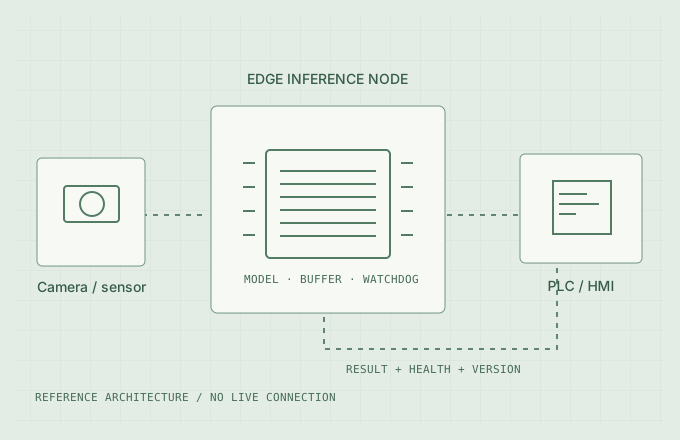
We select tools around image quality, control ownership, timing, data reliability and maintainability. The architecture is the connection between those choices.
Sensing & acquisition
Define the physical signal and the conditions required to acquire it consistently.
Vision & learning
Compare conventional vision and AI candidates against representative inputs and explicit defect criteria.
Edge execution
Benchmark latency, memory and thermal behavior on the target device, including unavailable-result states.
Machine control
Keep sequencing, actuation permissions and machine recovery inside the appropriate control system.
Industrial communication
Agree on device support, data mapping, update rates, connection behavior and network boundaries.
Industrial software
Preserve timestamps, quality flags and traceability through operator interfaces and production records.
Failure behavior belongs
in the architecture.
Missing images, low-confidence inference, late results and broken connections are operating states to design for. Every interface needs an owner, a timeout and a recovery path.
- AI supplies a result; the controller validates whether it may be acted on.
- Emergency stops and protective functions remain in the safety and power-control design.
- Job identifiers and acknowledgement prevent results from applying to the wrong part.
- Stale or unavailable data stays visible to the operator.
What does your process
need to do better?
Share the part, the machine, the constraint and the result you need. That is the starting point for a useful technical conversation.